My Top Video Games Of All Time! - Part 1

General / 16 March 2024

As my journey into Game Development continues, I often break down games, test and try to find weak points, understand the game mechanics and work out ultimately what makes it fun, rewarding or frustrating to play.

These are my top favourite games, ever in no particular order:

Firewatch
The colour palette for this title is amazing, the artists did a wonderful job of turning the environment into a beautiful journey. The gameplay is simple and the storytelling between Henry and Delilah is just pure romance. I would love a second Firewatch game.

Bishi Bashi  
Way back in the day, this was my Smash Brothers. We played this game hard, for several years and I still love it. This was my first real insight into how games don't need to be high-end graphics to be good but rather gameplay and fun are still major pillars. Bishi Bashi VR, yes, please!

Skyrim 
Ye gods! I seriously lost myself in this game. The mods took over and I even started making my own. Nothing ready for the 'Nexus' but changing armour colour and kitbashing pieces together. The Story by itself was pretty decent but the attention to detail, the dialogues and companions for different quests were just the best I'd ever played. The environment was just breathtaking and I found myself sometimes just waiting on a high mountain for the sunrise or the aurora borealis at night. The random events and secret locations still have me wanting to play this game more.

Wipeout
Still one of the best racing games in my opinion. 'Redout' comes very close but it doesn't win points for originality. The visual art style by the 'Designers Republic' was a strong influence on my own early art design, and it was completely due to this game. I still remember 'missing' a class at Art College so I could get the first copy of Wipeout 2097 in my town. Totally worth it and I still own it to this day.

The Witcher 3
Just as immersive and world-building as you'd expect from CD Projekt. I actually found the main quest a little underwhelming as the hundreds of amazing side quests felt slightly more important. The depth of the world is incredible and the graphics are just beautiful but it was the serious detailing and storytelling that will always draw me back to this franchise. I wonder what Netflix will do with the show.

Horizon Zero Dawn
The developers at Guerrilla Games made a lot of good design choices and immersed the player in a gorgeous world filled with incredible locations, great ncps and some very big robot dinosaurs. There is a whole series on YouTube by 'Noclip' which documents how they made it. It well worth spending the hours watching them all if you enjoyed the game. Having no multiplayer was a great decision. Staying focused on the core mechanics and getting the Art and gameplay right first. I'm sure HZD2 on the PS5 will definitely include this, and this is why many people also bought the Kickstarter game board game (and all the cool minis) so they could play with friends. The world-building was already done perfectly, now it's time to get your hunters together and work as a team.

Mario World
Although we never owned a Nintendo growing up, some of my friends did and this was my first real Mario game. Gameplay, level design and character development really made this shine as a well-presented and perfect Mario game. Gotta love that Yoshi.

Street Fighter Alpha 3 
The artwork, volume of characters and smooth animation style made this a classic. The sheer number of special abilities, combos and counters was insane. It really had it all. I don't feel like anything after this has come close to the Streetfighter franchise.

Disney Infinity
A level designer's dream. Actually, the main games are pretty fun and the characters and animations are very well produced. I really loved the 'sandbox' community and collecting the great figures. The 'toys to life' genre is still just alive with the new Starlink game but it still hasn't found the right market. Having the ability to make your own levels in the Disney franchise with al the licensed music and share them with friends was just brilliant. With thousands of YouTube videos to help get the programming node correct, you were only limited by your imagination.

Doom (2016)
Back in Hell and loving it. Wow, what a refreshing relaunch of an old title. Doom has pushed the first-person shooter franchise since it's original creation. The new Doom empowers players to keep moving forward, rewards players for using glory kills and keep you just bearly alive with a dynamic health bar system. You are the demon in the game, everything else is just dead. They just don't know it yet. Playing on strong environmental storytelling, a fantastic background score and a huge range of upgradeable weapons made this game a complete joy. But wait, there's more! The game also included a sweet multiplayer system that rewarded players to completely upgrade and customize their own doomguy. The downfall was, that the main game was just too good. And then, there was 'Snapmap'. Use easy pre-assembled assets and rooms to create your own levels and share them on the community servers. Just like Disney Infinity this produced some incredible levels and I really enjoyed this aspect. I really hope Doom2 will continue with this feature.

Portal 2
Who ever thought a physics logic game could be this much fun? The storyline is simple yet rich and with a side helping of cake. Great level design with some serious mind-bending puzzles. Great for replays and perfect for VR. The character design is also something that stood out for me. It uses a negative parental guidance system, often putting the player down and making fun of you when you complete a task. This can actually help you by doing the opposite, creating a story animosity and pushing the player forward. As you escape rooms only to find out it was just part of a secret test, you start to discover more backstories for GLaDos, Atlas,and  P-body. Making your way around the Aperture Science Facility and listening to J.K. Simmons's voice act for Cave Johnson was a really nice touch. I think it's time to play this game again.

Half-Life 2 
Still considered one of the best games ever, it certainly lives up to it's name. Half-Life 2 isn't just a game, it's an experience. Streaming-level design with minimum loading times really kept the player immersed in the game. The core first-person shooter is solid whilst breaking up the action with animated cut scenes. It was also one of the first few games to really use real physics puzzles effectively.

Golden Eye 
Great fun back in 1997, one of the first multiplayer shooters that we played religiously. It has some great level design, a pretty decent main game following the events of the film, plenty of weapons and tons of playable characters. With Hollywood stars like Pierce Brosnan, Famke Janssen, Sean Bean, Alan Cumming and Robbie Coltrane it was hard to pick one. Oh all right, everybody knows that Oddjob was technically cheating but did you know that Boris is invincible! (Actually, turns out he's not) but Mishkin is pretty tough. Equipped with body armour, he could survive a headshot from the golden gun!


That's it for part 1, I need more time to keep developing my portfolio and prototyping. See you soon for part 2!

Report

A practical guide to Game Design

General / 14 March 2024

I love games, I really do. From cards, and video games to board games I'm hooked.

What's better than playing a great game, building your own mods and adding 'house' rules.

As a wee young boy, we had the standard household games such as Monopoly, Cluedo, Risk and Snakes and Ladders, but nothing was more exciting than playing Draughts with my Mum. I remember she was merciless. But I remember clearly thinking about it like soldiers fighting in a medieval war and far more fun than the other games.

A few years later, back in 1984 we also got our first home computer, his name was Arnold and he was the Amstrad CPC64. I started learning AMSDOS so I could create my own RPG games. Typical the ones like "You are standing in a forest, there is a mountain to the north, a wolf den to the East and the City of Bones to the West. Which way do you want to go?" Kids these days really don't know what they missed out on.

The next natural progression should have been Chess, but that wasn't even in the same league as the new game. Christmas had bought me 'Heroquest', and my life was changed forever.

It wasn't all the figures (man those figures!) and the gorgeous game board, but the stories. The Adventures of gold, blood and wine. It was just fantastic.

Naturally, this did lead me to Games Workshop, Fantasy and 40K and then a little later, more serious RPG games.

No, I don't mean those wonderful series of 'Fighting Fantasy books by Steve Jackson and Ian Livingstone but the much darker Dungeons and Dragons.

I quickly found that depending on the dungeon master, the focus of the game would alter incredibly. One week, our heroes would be knee-deep in Orc blood holding back the tide of death against the innocent villagers, and the next week would be pillow fights with the tavern owner's daughters and killing everyone in a bar brawl. I knew which story I liked better.

Dungeons and Dragons gave way to White Wolf's World of Darkness. I usually hosted as the game master and also played the main villain character and any character opponents. I did not realise it then, but I was starting to create a web of stories and characters, that month by month would tell a tale of betrayal, death, resurrection, revenge, glory and finally misfortune. Almost straight out of a Shakespearean novel. (Almost)

I still have my copy of Heroquest, and once in a while a friend will come along with nostalgic memories and we'll have a game. The last time we played though, it turned into a year-long adventure as I built new rules and quests, brand new character sheets and turned it into a mini D&D RPG Skyrim cross-over game. Serious, a 60-page expansion rule set isn't really the same game anymore. (Don't even get me started on Skyrim or Witcher)

Jump a bit in time, and I'm having fun playing Decent and Eldritch Horror (of course with 'house' rules) but what is it about these games that make people love them, stand the test of time and draw you in again decades later? Simply, Storytelling and Game design.

So how do you make a timeless game with challenges and replayability?

  • Creative dynamic systems 
  • Inventive compelling game mechanics 
  • Fascinating settings 
  • Developing the medium 

Game design is its own discipline. But it always borrows and builds upon other modes of creative work. Game design is:

  • Art 
  • Probability and Math 
  • Literature and language 
  • History and Geography 
  • field of play 
  • Encouragement of repeated patterns of behaviour 
  • Player competition 
  • Player cooperation 
  • Skill Mastery 
  • The study of player psychology

Managing Audience expectations is a huge hurdle to overcome. Game designers will often be asked by players and clients to deliver the same but different, whilst changing and improving on everything. Catch 22.

Immersive Play

Immersive play is something that a lot of people talk about and everyone has their own theory, some even more obscure discussion related topics like reward ratio, reading saccades, Skinnerian response, interface design and more. Immersion is the sense that a player is deeply connected and invested in their character or part in the game.

However, immersion is different for every player, as long as the designers provide a wealth of options and graphic designers and animators provide compelling images, gamers will find a role they like and take to it. Immersion is important but not central to design, but rather a consequence of good design practices at a different level, mechanical design, character design and world design.

Process of Creative Thought

Creativity is at the heart of good design, but it's an overused word. The work of creativity is different from analytical or physical work, but it is still a process that can be mastered. David Kord Murray's Book, Borrowing Brilliance tries to systematize and demystify creative thought for the engineering and technical professions. Murrays states that the creative thought process can be taught and that you can become better at it with practice. I also believe that this is true because it follows the simple logic, practice makes perfect. Creativity improves in quality over time, for instance, a new developer's first game is held to a lower standard than their later work.

Evolution and incubation

Puzzling over the elements of a game doesn't always get you very far. Sometimes, the combination of ideas provides a solution. The first three elements of creative thought are about the inputs to your subconscious. Trying to force everything together in a rush usually doesn't lead to good results. Pushing the design process requires time to pause and think. Work out what you enjoy about the game, and what bothers you, and then figure out how to correct it.

The Mechanical hook

Find a unique mechanic hook, every game has one. It may be pure inspiration but usually, it comes from somewhere else. Keep pushing until you find something that will set your game apart from all the others. Hard work at the start will make the final weeks of production flow better. Playtesting is very important. you may think your hook is great but if it doesn't work within the game then it's time to review it. An example are 'Machi Koro', the hook is that it's a simple-to-play game yet with a hidden tactical system with both players potentially benefiting for other players' turns. 'Escape the Curse of the Temple' has all players rolling and taking their turn simultaneously which leads to a fast and frenzied gameplay which is perfect for the game setting. Finally, the aforementioned 'Heroquest' had a great combat dice system with different symbols to indicate attacks or defence, yet still felt unrealistic for combat so with some new house rules, heroes and monsters would roll simultaneously adding any new special abilities. This felt more dynamic and fun.

Resolutions Systems

Every game uses a different method of determining success or failure. This can be tied together with the mechanical hook to make a better experience.

Figuring out the probabilities and base chance is important, this will have an effect on gameplay, replayability, balance and enjoyment. Creating more powerful in-game items is great but it means that everything before is now obsolete unless the can be upgraded. 'Destiny' suffered terribly from this. Once you had your Gjallarhorn and Thorn, you were unstoppable, so what did they do. Introduce buff and nerf to balance out the items. A terrible solution as players had already invested hours worth of game time to get these times. They then later tried to correct this with an upgrade system but this too became pointless, as the new DLC packs introduced even more powerful weapons and armour. This poorly designed system was based on the incentive that buying the DLC would give you better equipment than other players, which is basically 'pay to win'. I really hope this is changed in the second game.

Action and Time systems

What counts as an action, and what order should actions be performed? How long is a unit of time? Can the Mechanical hook and Resolution system affect these? It's hugely beneficial and important to set these foundations at the start before building the game.

Consequences

Consequences and reward. Is the goal of the mission worth it? Random rewards might keep a small amount of players will grind for a while but eventually, the drop-off rate will be enough to make the game unplayable. Having a staggered reward system helps incentivise players to keep grinding but it can become repetitive and boring. A lot of mobile games are simply just tapping the screen repeatedly until the end of the level to be highly rewarded, then repeated for an even better reward or allow the player to skip a level by paying to do so. 'Witcher 3' has some great consequences built into the story of the game. A lot of side quests start out fairly simple promise that no good deed goes unrewarded, yet somehow turns into an enjoyable multi-quest which links together with other side quests to form complete narrative stories. Often doing the moral thing has negative effects later in the story but the immediate final reward is worth it, producing a balanced experience and consequence system.

Main goal

Introduction to the main goal of the game should be fluid and simple, often this is the first thing the player will learn about the game. The primary story delivery method needs to be easily understood and straightforward. This is usually told in a few different ways and is a good way of allowing the player to uncover the main goal whilst playing a tutorial level.

Sea of Plots and Shackles of Stories

Having one story can work well with some games but to increase player enjoyment, emersion and replayability often there are several stories all carefully woven around the central plot. Taking the time to invest in these side stories will help develop characters, gameplay and game items.

Add some Jalapenos

Yeah, get schwifty! Mix things up. Throw in some curve balls and overpowered items. Players love being OP. Arrange things so that players gain satisfaction and invest in their characters. Tailor the player experiences to your plots and what they enjoy doing or can't resist. Of course, having too many Jalapenos will ruin the party.

Growing mighty and a good ending

The end of the game is equally important to the start. Was it worth all the effort? Usually, by the end of the game, the characters are overdeveloped and have all the best items. Unless monsters level up too, this can make the game feel flat and unchallenging. Having Super boss fights will help incentive players to push harder for better gear but ultimately will lead to an unsatisfying end. Rockstar's 'Red Dead Redemption' deals with this is a great way. (SPOILER) At the end of the game, there are still a few things to be done, yet the main player is pretty powerful and hunting down a grizzly bear or a few outlaws might not seem interesting now. So, they treat us to an emotional rollercoaster of great storytelling closure, and kill off the main character and allowing the player to over the role of his young son. This then opens up more open stories and missions to finish. You end up finishing at the start, not having the best equipment in the game but feeling ultimately rewarded.

Location

Having the right game world location is crucial. Not only will this shape the gameplay mechanics but also the characters and immersion.

Realities of Game Balance

The easiest way of breaking your game is to overpower players, pay to win items and unbeatable monsters. Having powerful items is great as the players enjoy them for a short time but then they start to become a problem in the game mechanics and story. Balancing a game can be done in many ways, mathematically working out the percentages is a quick way of analyzing where things are going wrong and by simply having these items as a one-time use. Story elements can be used to force the player to remove, give up or have these items stolen which can add to the experience.

Sandbox Pitfalls

The open-world experience was a big deal a few years ago. Games had to tick three boxes to even be considered good. They had to include a single-player campaign mode, and multiplayer mode and be set in a sandbox environment where you could literally go anywhere. Experience has told us, that sandboxes are usually boring low textured places with not much happening between events and filled to monsters which slow the story. However, some games get it right. Each environment is treated with the same attention to detail, just because you're in a desert or grasslands doesn't mean there should be a lack of side quests or story elements to uncover.

Forward Momentum

No matter what, the game needs to keep moving forward. If things start to get too technical the base mechanics need to be adjusted. Having a game which isn't fun won't last long.

Critique with Kindness, Revise with a butcher's knife

When combining ideas and mechanics together to create a game or story it's important to understand that you can't critique in a way that's too abrasive or too passive. By stating that someone's work is no good will lead to bad collaborations and an arrogance that will develop into Delusions of Grandeur.

In reality, the results won't be that special or unique, because anyone with a difference idea or style will be driven away. Doing what everyone else is doing isn't the way to develop or generate new business opportunities, but it does help pay the bills. Honest compassionate criticism is needed, with supporting advice on how to improve. Accepting criticism can be hard too, sometimes stepping back before responding is necessary and evaluating if this is the right project for you can be helpful.

Fail early and hard

Learning to fail is difficult because we all want to get it perfect first time. This is impossible and anyone that tells you different is either extremely lucky or lying. The problem with getting it right the first time is that you don't learn anything, you don't struggle. Making anything requires training, skill and time. Failing is a positive. Quitting is the failure.

A nice Japanese quotation I've always remembered is from the Hagakure. "The Shogun prefers to employ men who have made mistakes. They will not make the same mistake twice in his service."

Report

Unreal Engine - My Basic Master Material Set up

Tutorial / 13 March 2024

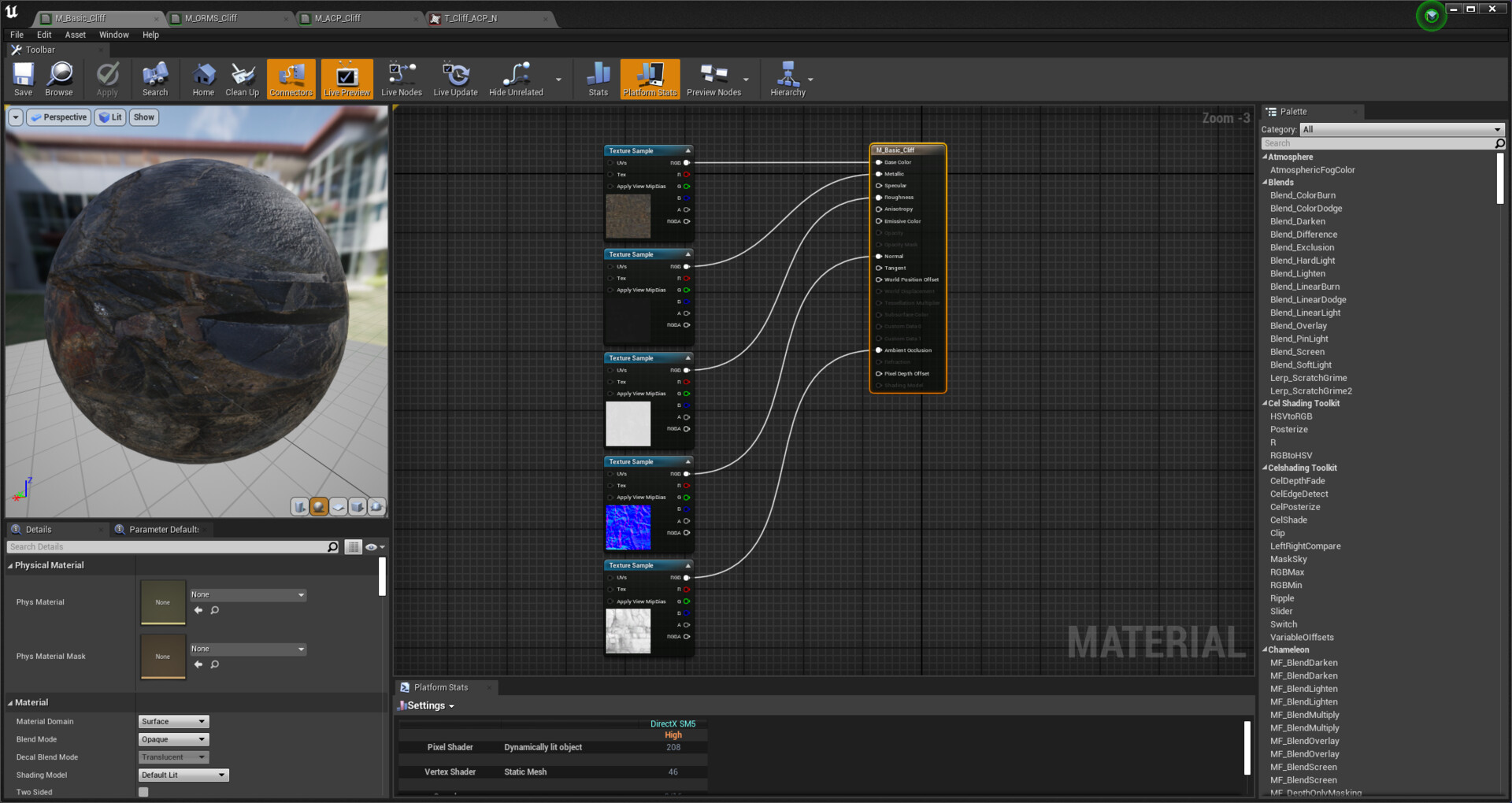
Every project there are a few things you need to do every time. Usually, this is creating a material library. Tedious, but it's important to get it right at the start as having to change this stuff can be a time-consuming nightmare. Having a set of standardised Master Materials to import into the project can really save a lot of time. I have a few different sets including some crazy advanced materials and functions. But more on that later. Today is all about the Basics.

The 'Lite' set up is day 1 stuff. This is the basic input for setting up the materials in Unreal. No parameter-driven controls or tints, just the maps:

Below, we have the same set-up but with some controls, perfect for material instancing. Texture coordinates for scaling are placed in the custom UV pin as this is a bit cheaper than individually adding it to all the textures:

So, it's all working but it needs a little bit of optimisation. 3D texture software like Substance Painter can output combined Maps called ORMS. These are mostly industry standard with the RGB channels used in the same way, but if you combine them yourself, you can use any channel for anything. This can be as lite as you want or as heavy. But don't be fooled into thinking that having a super master material with everything is the go-to for all your needs. If the texture artist has done a spot-on job and you don't need to alter anything then just use a lite material. This will not only optimise your project but also reduce the file size when shipping. Some background assets only really need an Albedo and a tint!

Masked Materials are cheaper than Transulcent (and if shipping on mobile / VR, use Additive rather than Translucent.)

This material set-up is the same as the ORMs basic but it's using an opacity mask. Usually, this can be applied to the Alpha in the Albedo texture but using a switch we can also add it later as a separate mask without having to redo work. It's good to plan out the material structures at the start of the project and stick to the same workflow for all artists:

Sometimes you need World Aligned Textures. Here the texture maps are separated into different parameter texture objects. Usually, you'll only need an Albedo and normal but it's possible to depending on the asset requirements:

When tiling in world space you can notice repetition of you're not careful. You can add noise maps to the base colour but also combine  a second set of maps with a different UV scale to create better textures:

This is probably as far as I would go with the basic materials. It's best to start creating Material functions to optimise the workflow and create better material organisation. Which leads me nicely into my next blog post.

If you want to speed up your workflow and download my Basic Master Materials, you can do so here. They have been built in 4.27 and you can just drop them into the project contents folder. 


Report

Unreal Engine - Advanced Channel Packing

Tutorial / 12 March 2024

An advanced optimisation technique for packing data into texture channels that allows you to represent all of the texture data needed for a material in just two texture samples. Using this method saves both texture memory and performance, but since you're packing non-normal data in with the normal map, you do lose a little bit of quality in the normal. It also requires doing some extra steps in the shader to unpack the normal data.

Basic 5-Map setup:

1. Albedo / Diffuse
2. Metalic
3. Roughness
4. Normal
5. Ambient Occlusion

ORMS 3-Map set-up:

Does exactly the same as the 5-Map material but in 3 texture maps.

1. Albedo / Diffuse 
2. Metal, Roughness and AO 
3. Normal

Advanced Channel Packing 2-Map set-up:

Does almost exactly the same as the 3-Map material but in 2!

1. Albedo / Diffuse + Roughness in the Alpha Channel
2. Red and Green Channel for Normal, Blue for AO

Make sure SRGB is set to off and to use BC7 in the compression settings for the textures, and blend mode is set to Linear colour.


Report